 |
 A game development diary (and other stuff too)
|
Internal Link
(opens in same window)
External Link
(opens in new window)
Broken Link
(likely 404 error)
|
|
26 Nov 2011 -
The adventure in progress
|
|
Earlier this year I quit my job in the technology industry and started working for myself making games. I formed a company, Order of Magnitude Games, and intend to release my first game early next year.
For the most part I will be moving all blog activity to my company site at oomgames.com. You can also Like me at facebook.com/oomgames or follow me on Twitter @oomgames.
I'm having tons of fun, but things are proceeding more slowly than I anticipated. I need to start making money by mid next year in order to keep doing this. Otherwise it will be back to the grind for me.
I'll post important news here, like game releases.
|
|
14 Mar 2011 -
An end and a beginning
|
|
Almost a year since my last post. What better way to break the hiatus than with some exciting news (for me).
The end of March will mark my last day at NVIDIA and my first day as an independent game developer. My wife and I are finally at a point financially where we can take the risk and allow me to try this game development thing full-time.
About six months ago I went through a round of interviews with several local iPhone game companies. I explained how I learned Objective-C and iPhone programming. I showed them demos and videos of the games I have made over the years. I believe I did well on their interview programming questions. Despite that I did not get any offers.
I am convinced that unless you are already in the game industry it is almost impossible to get a job there. I'm not surprised - I've read and known about that exact problem for years. Still, it's disappointing that I couldn't find a company willing to take a (relatively small) risk by hiring me.
So I'm going it alone. Starting in April I will be working from home in an effort to launch my gaming career. Wish me luck.
|
|
23 Apr 2010 -
Objects abound
|
|
Game Progress
I was hoping that this post would contain a video of my work in progress running on both my iPod and iPad. To do that, though, I need to (finally) sign up for the Apple developers program. And to do that I need to sign their epically long developer agreement. Since I am taking this very seriously I want to read the whole thing before spending the $99. Also it may turn out that some clause prevents me from posting updates. For now I will carry on posting as usual.
As for programming progress, I have started the framework for adding arbitrary objects to the play field. My base object is basically the same thing as a peg - static and does not react when a ball hits it. Classes derived from this will add more capability. In fact I just realized that the Launcher and Bucket objects I created can, should, and will be converted to subclasses of the general object. It makes tons of sense and is just cleaner that way.
Before this realization I had started adding a "Bumper" subclass that behaves like you see on pinball tables. Balls striking it will be propelled away. I haven't tested it yet, but it allows me to test some of the features in a more complex object: collision callbacks and time delays for resetting.
I'd also like to put out a call for an artist to help me put decent graphics in this thing. I'm sure not many people read this blog so I'll be posting elsewhere later, but thought I'd give it a shot here first. Drop me a line if you are interested.
|
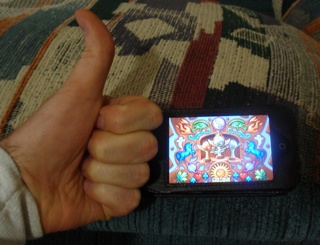
Jeez Louise, it's great to have that game firmly in the finished column. I completed the last two levels and achieved my Extreme Grand Master trophy. I will eventually put up some vids of especially good shots I made in the game.
So how did I tackle those last two levels? First up was Billions & Billions (the one with the flying saucer). I reasoned that since the saucer was the only moving object other than the bucket I might be able to use the same strategy as the previous two levels. This turned out rather well. First, I cleared all the pegs possible by firing straight down. Then I went to the far right.
The problem with firing to the sides arises when the ball enters one of the two holes and comes out the flying saucer. Luckily I found a pattern that allowed me to catch a free ball. I timed it so that the ball entered the hole, fell out of the flying saucer and straight into the bucket without touching any pegs. That ensures that it is repeatable and deterministic.
Then, as I was trying to figure out the next shot I had a good streak of lucky bounces. I decided to try clearing the level and was able to do it. Whew!
The last level, Beyond Reason, is the one with the double helix. For this one I followed the advice on the Pop Cap site. I used Splork and kept restarting until the two green pegs were in the center helix. Hitting both in one shot along with the purple peg gave me three extra balls. I got lucky and bucketed the ball as well so I ended up with 13 balls and just the bottom third or so of the helix remaining. I got a bunch of lucky bounces and ended up clearing the board. The stationary pegs are pretty easy. You definitely need to get good at anticipating the bounces off non-moving pegs to have a chance.
And after all this I'm still seeing new sayings during the load screen (Just now: "Polishing claws").
|

This web page and all other pages on this site are
© 1999-2007 Scott Cartier
|